Why choose Aluminium Doors And Windows for global projects? The answer begins with performance, not appearance. Buildings currently account for around 34% of global energy demand and 37% of energy and process-related carbon emissions, according to the 2024 Global Status Report for Buildings and Construction from UNEP and the GlobalABC. Every frame, seal, and glass unit therefore matters.
Aluminium offers a strong, lightweight structure for large openings, narrow sightlines, and demanding façades. It also supports durable powder-coated or anodised finishes in coastal, humid, and high-traffic environments. With thermal breaks, low-emissivity glass, warm-edge spacers, and properly designed gaskets, these systems can reduce heat transfer substantially. The final result depends on detailing and installation. A poor perimeter seal can undermine an expensive window.
Recycling strengthens the material case. The International Aluminium Institute states that recycled aluminium requires about 5% of the energy used for primary aluminium production. It also reports that roughly 75% of all aluminium ever produced remains in use today, reflecting long service potential and material value. These figures support circular design, although they do not excuse careless sourcing or weak fabrication controls.
Experience on international projects shows that climate, orientation, drainage, wind pressure, and maintenance access must be assessed together. A successful specification should reference verified thermal, air, water, and structural test results, while meeting applicable local standards. No material wins everywhere. Aluminium can conduct heat, and its environmental benefit depends heavily on recycled content, electricity sources, and service life. That limitation deserves attention. The strongest global choice is not simply aluminium; it is well-engineered Aluminium Doors And Windows, installed by qualified teams and documented from factory to building.
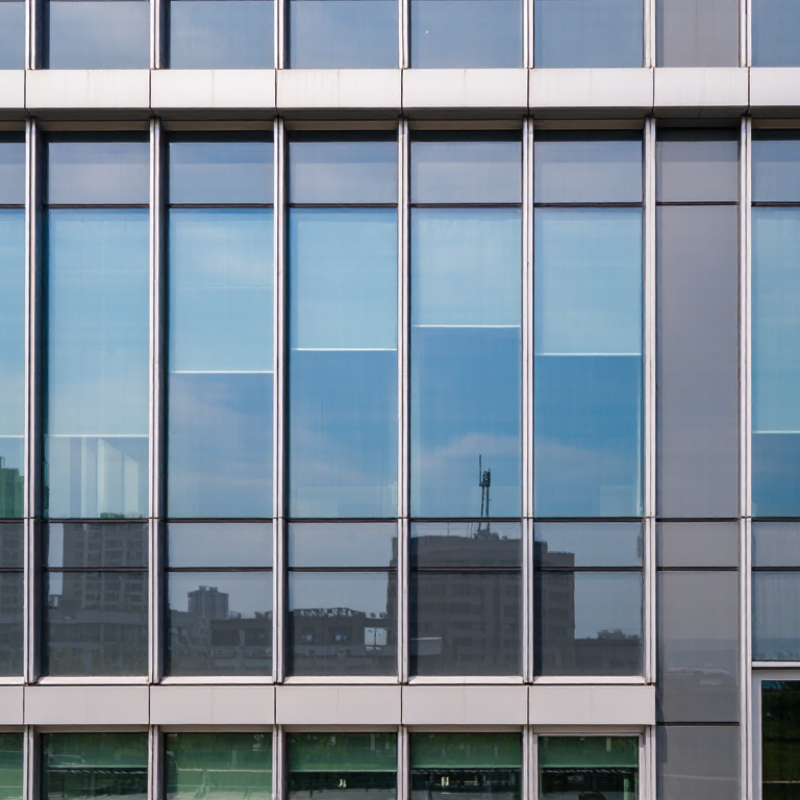
Why Choose Aluminium Doors And Windows for Global Projects?
Material Basis: Aluminium’s Strength-to-Weight Ratio Supports Large Glazing
Aluminium offers a practical balance for projects that require wide glass panels and slim frames. Its high strength supports substantial glass loads without creating excessively heavy assemblies. This matters in airports, offices, hotels, and public buildings with expansive elevations.
On site, installers often handle frames through narrow access routes or upper floors. Lighter components can reduce lifting effort and simplify positioning. Yet strength alone is not enough. Engineers must check wind pressure, glass weight, span, connection points, and local movement requirements. A frame that looks slim may still need deeper sections in exposed locations.
Aluminium also keeps its shape well when properly designed and fabricated. Thermal breaks can improve indoor comfort by reducing heat transfer through the frame. Drainage paths and sealed joints remain important, especially in regions with heavy rain or coastal air. Small detailing errors can become expensive later.
Large glazing changes how people experience a building. Daylight reaches deeper into interior spaces, while narrow sightlines create a cleaner visual connection outdoors. However, more glass can increase solar heat and glare. That trade-off deserves careful review, not optimistic assumptions. Coatings, shading, ventilation, and orientation should work together.
The material is dependable, but not automatic. Project teams still need tested systems, accurate calculations, skilled installation, and regular inspection. Regional conditions can expose weaknesses that drawings did not reveal.
| Engineering Dimension | Aluminium Alloy Reference | Typical Structural Steel Reference | Practical Relevance to Doors and Windows | Data Basis |
|---|---|---|---|---|
| Material density | Approximately 2,700 kg/m³ | Approximately 7,850 kg/m³ | Aluminium is approximately 66% lighter by density than typical structural steel, helping reduce the dead load of frames, sashes and associated hardware. | Typical density values for aluminium alloys and carbon steel |
| Yield strength | Approximately 145–214 MPa for common 6063-T5 to 6063-T6 extrusion tempers | Approximately 355 MPa for S355-grade structural steel | Aluminium extrusion strength depends on alloy, temper, section geometry and heat treatment. Profiles must be engineered for the required wind, impact and service loads. | Typical minimum values associated with EN 755-2 and EN 10025-2 material grades |
| Elastic modulus | Approximately 69,000 MPa | Approximately 210,000 MPa | Steel is stiffer per unit of material, but aluminium can achieve efficient frame performance through deeper, hollow and multi-chamber extrusion geometries. | Typical isotropic material values used in structural design |
| Specific yield strength | Approximately 54–79 kN·m/kg | Approximately 45 kN·m/kg | When yield strength is considered relative to density, common 6063 extrusion tempers can provide an efficient strength-to-weight basis for lightweight framing. | Calculated as yield strength divided by density; indicative comparison only |
| Thermal conductivity | Approximately 160–210 W/(m·K) for 6063 aluminium | Approximately 45–60 W/(m·K) | Aluminium conducts heat readily, so thermally broken frames, insulated glazing and correctly designed seals are important for energy performance. | Typical published engineering-property ranges for aluminium and carbon steel |
| Linear thermal expansion | Approximately 23.5 × 10⁻⁶ /K | Approximately 12 × 10⁻⁶ /K | Allowance for thermal movement is required in long curtain-wall runs, large window assemblies, joints, anchors and perimeter interfaces. | Typical coefficients of thermal expansion used in building-envelope calculations |
| Example mass of a solid 3 mm sheet | Approximately 8.1 kg/m² | Approximately 23.6 kg/m² | For equal sheet thickness and area, aluminium creates a substantially lighter component; actual frame weight depends on profile design, reinforcement and glazing specification. | Calculated from density × thickness: 2,700 × 0.003 and 7,850 × 0.003 |
| Extrusion suitability | Highly suitable for complex hollow and multi-chamber profiles | Generally less efficient for the same detailed hollow window-profile geometry | Extrusion enables integrated drainage paths, glazing rebates, thermal-break pockets, screw channels and reinforcement zones in one continuous profile. | General manufacturing characteristic of aluminium extrusion systems |
| Large-glazing design implication | Low frame mass with scalable profile geometry | Higher material density and greater stiffness per section | Aluminium can support visually slim frames and large glazed areas when profile deflection, glass weight, wind pressure, anchorage and safety requirements are verified by calculation. | Performance depends on the complete tested or engineered door and window system |
Note: Values are representative engineering data for material comparison, not guaranteed properties for every product. Final global-project selection should be based on the specified alloy and temper, profile dimensions, glazing weight, design wind load, thermal requirements, applicable local standards and project-specific structural calculations.
It limits heat transfer through the frame and glazing. Lower U-values usually support steadier indoor temperatures and reduced heating or cooling demand.
An insulating section separates the inner and outer aluminium surfaces. This reduces thermal bridging across the frame. Small gaps still matter.
Not always. Low-emissivity double or triple glazing may improve performance, but solar control must match local temperatures and sunlight.
Frame depth, thermal breaks, glass layers, edge spacers, seals, drainage, and installation quality all matter. One weak corner can reduce overall efficiency.
No system can guarantee that result. Building orientation, ventilation, shading, occupancy, and local weather also influence energy use.
Buildings use roughly 30% of global final energy. They also create about 26% of energy-related emissions. The exact share changes by reporting method.
Aluminium can provide long service life, repeated recyclability, and resistance to rain, sunlight, and daily use. Poor coatings or damaged hardware still shorten its life.
Review indoor humidity, ventilation, surface temperatures, and local climate conditions. A laboratory result may not match the finished building. Site checks are necessary.
Confirm local code requirements, corrosion resistance, recycled content, environmental data, and whole-window performance. Review hinges, seals, drainage, and installation tolerances.
Yes. Poor sealing, inaccurate alignment, or damaged thermal breaks can weaken an efficient design. The specification may look excellent, but the site can disagree.
Aluminium Doors And Windows are a practical choice for global construction projects because aluminium combines high strength with low weight, allowing architects to create larger glazed openings without placing unnecessary loads on the building structure. With appropriate thermal breaks, glazing, and system design, aluminium assemblies can achieve low U-values and support compliance with energy-efficiency requirements in different regions. Their durability, dimensional stability, and design flexibility also make them suitable for diverse climates and building types.
Sustainability and lifecycle value further strengthen the case for aluminium. According to the International Aluminium Institute, recycling aluminium requires about 5% of the energy used for primary production, helping reduce resource consumption when effective collection and recycling systems are available. The institute also reports that approximately 75% of all aluminium ever produced remains in use, reflecting its long service life and recoverability. For international projects, selection should compare EN, ASTM, ISO, and local performance standards to ensure the chosen systems meet regional requirements for safety, thermal performance, air, water, and structural resistance.

 Fortis Window